


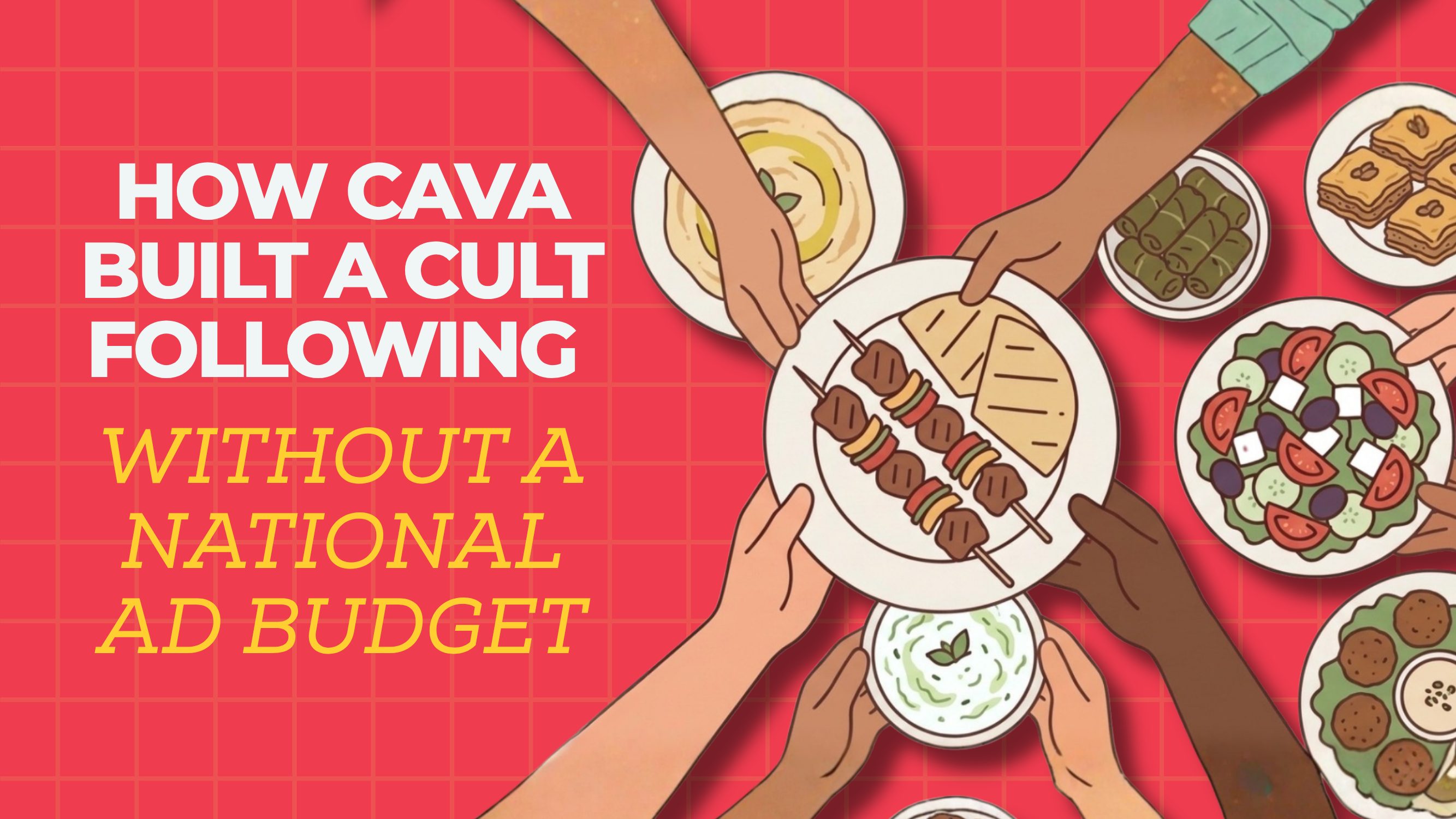
How Cava Built a Cult Following Without a National Ad Budget
Cava didn’t outspend Chipotle. It didn’t out-locate it either. For years, Chipotle had thousands more stores and a marketing budget to match. And yet Cava built one of the most talked-about, most-imitated fast-casual brands in the country, with people genuinely excited to wait in line for a grain bowl.
The difference wasn’t the budget. It was specificity. Cava out-designed and out-cultured the competition, and that’s a far more repeatable lesson for a growing brand than “spend more on ads.”
Here’s what actually happened, and why it matters even more for brands built around cultural identity and multicultural audiences.

Budget Isn’t the Barrier to Standout Branding. Clarity Is
The instinct, when a brand wants to grow faster, is almost always to spend more: more ad placements, more sponsorships, more reach. But reach without a distinct identity just means more people forgetting you faster.
Cava’s growth came from clarity, not volume. Every touchpoint, from the packaging, the menu language, and the in-store experience, reinforces the same identity instead of diluting it across generic “healthy fast food” positioning. That’s a multicultural brand strategy lesson as much as a design one: a smaller, sharper message beats a bigger, blurrier one almost every time.
Juicer Tip: If your brand’s touchpoints don’t all reinforce the same identity, the issue usually traces back to inconsistent design fundamentals. Our piece on The Basics of Graphic Design breaks down the principles that keep a brand’s look cohesive across every surface.
Product Design as a Brand Touchpoint, Not an Afterthought
Cava treats its menu itself as a piece of brand design, not just a list of items. The bowl-building format, the ingredient names, the way dishes are described; all of it communicates the brand’s Mediterranean roots before a customer takes a single bite. Compare that to a menu that reads like a generic list of interchangeable options, and the difference in perceived value is significant, even at a similar price point.
This is a lesson that scales far beyond restaurants: every product, every service description, every piece of collateral is a chance to reinforce identity or quietly erode it. A cultural marketing agency worth hiring treats every one of those touchpoints as brand work, not just operational necessity.
Cultural Authenticity, Not Generic Positioning
Here’s the part that matters most for multicultural brands specifically: Cava never tried to be “healthy fast food for everyone.” It leaned into its specific Mediterranean roots, confidently, and let that specificity be the draw rather than something to soften for broader appeal.
That’s a direct contradiction of the instinct many brands have when trying to reach a wide audience: the instinct to smooth out anything too specific, too cultural, too “niche,” in favor of language that could apply to anyone. But audiences increasingly want the opposite. They want brands that know exactly who they are and speak with real cultural intelligence, not brands performing a watered-down version of authenticity.
Juicer Tip: Building a brand around genuine cultural specificity, rather than diluting it for broad appeal, is where real differentiation lives. If you’re rethinking a brand’s visual identity around this kind of clarity, The Logo Design Process shows how that specificity gets built into a mark from the first sketch, not bolted on afterward.
Community-First Growth Over Broadcast Advertising
Cava’s store openings and social strategy consistently prioritize local, community-first moments over broad, expensive broadcast campaigns. A neighborhood event, a local partnership, a hyper-specific social post that only really lands with people who already know the brand’s world. These do more for genuine brand affinity than a generic national ad ever could, because they signal that the brand actually understands its community instead of just targeting it.
This is community marketing, not mass marketing, and it’s a far more accessible growth strategy for brands that don’t have Chipotle-level ad budgets in the first place.
Juicer Tip: Community-first growth depends on genuinely knowing where your audience already is, not just broadcasting at them. Our post on Top 3 Ways to Use Social Media to Drive Sales covers how to build that kind of community-first presence platform by platform.
What This Means for Brands Winning Right Now
The brands pulling ahead today aren’t necessarily the ones with the biggest spend. They’re the ones with the cultural fluency to be specific; to speak directly to a defined audience instead of a diluted, generic one. That’s the entire thesis behind multicultural brand strategy: cultural specificity isn’t a limitation on reach, it’s what actually creates depth of connection, which is what turns casual customers into the kind of following Cava has built.
For corporate brands still investing seriously in multicultural marketing (particularly in categories like auto, beauty, CPG, and healthcare) this is the moment to lean further into cultural specificity, not away from it. The brands treating cultural fluency as a genuine strategic asset, rather than a box to check, are the ones building real, lasting followings.
It’s worth naming the risk on the other side, too. The instinct to broaden a message until it applies to “everyone” doesn’t actually make a brand safer, it makes it forgettable. A watered-down version of a cultural identity reads as inauthentic to the exact audience it was meant to reach, while doing little to win over anyone else. Cava’s growth is a useful reminder that the math runs the opposite direction: depth of connection with a defined audience compounds into broader reach over time, in a way that shallow, generic appeal never quite manages to.
For any brand weighing that tradeoff right now (whether it’s a regional restaurant chain, a consumer packaged goods brand, or a healthcare system serving a diverse patient population) the Cava playbook offers a genuinely useful test. Before diluting a message to reach more people, ask what gets lost in the dilution, and whether that loss is actually worth the broader reach it’s meant to buy.
Who We Are
Creative Juice is an award-winning, multicultural and multilingual creative agency based in Atlanta, GA. For over 13 years, we’ve helped corporations, nonprofits, and government agencies build brand identities rooted in real cultural intelligence, not diluted, one-size-fits-all positioning.
We’ve had the pleasure of building brand and marketing work for organizations including Home Depot, Medtronic, LG, Chick-fil-A, Hartsfield-Jackson Atlanta International Airport, Equifax, MARTA, Georgia Tech, and The Gathering Spot, alongside a growing roster of government and nonprofit partners across the Southeast.
Whether you’re a corporate brand looking to sharpen your cultural positioning or a growing business ready to own your story instead of blending in, we bring the same thing to every project: strategic clarity built from genuine cultural fluency, not generic appeal.
Own your story instead of blending in. Let’s build it.