


What Duolingo’s Absurd Marketing Can Teach Serious Brands About Trust
The world’s most unhinged marketing mascot is also one of the most trusted brands in tech. A giant green owl that fake-stalks you into practicing Spanish shouldn’t work. And yet Duolingo has built one of the most beloved, most imitated brand voices in the world while your corporate marketing team is still getting three rounds of legal review on a LinkedIn caption.
Here’s the uncomfortable lesson in that contrast: a strong brand voice strategy was never about being polished. It’s about being unmistakable. Somewhere along the way, a lot of brands started treating “professional” and “boring” as synonyms and it’s costing them attention, memorability, and ultimately, trust.
This matters more than most marketing teams realize. In a crowded market, the brands that win aren’t always the ones with the biggest budget. They’re the ones people can actually recognize, remember, and repeat back to a friend. That’s the entire game of brand strategy, and Duolingo is one of the clearest, funniest case studies of it working in real time.
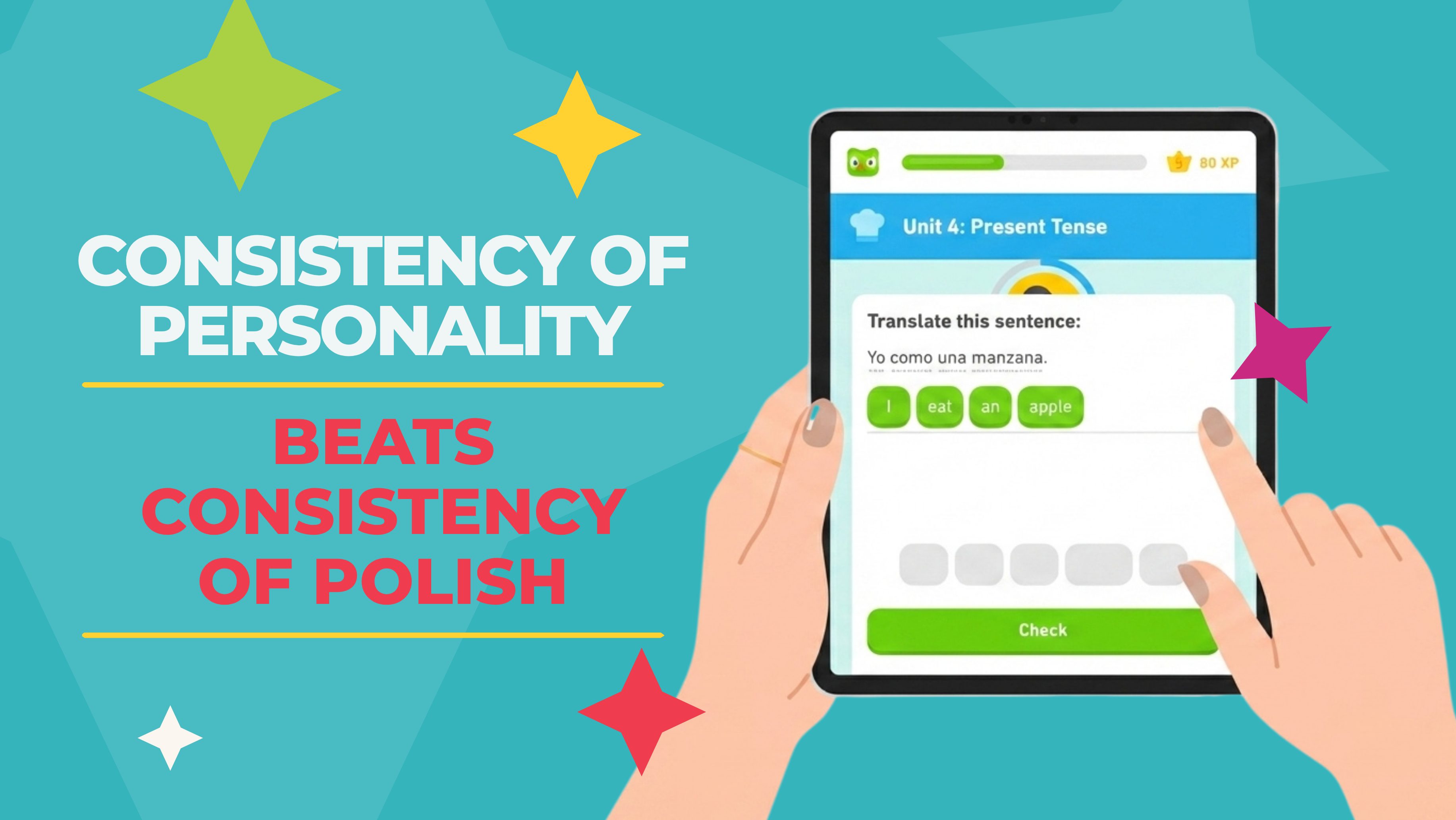
Consistency of Personality Beats Consistency of Polish
Duolingo’s TikToks aren’t polished. Half of them look like an intern made them in twenty minutes (an intern did). What they are is unmistakably, consistently Duolingo: same unhinged energy, same voice, post after post, platform after platform.
That consistency is what makes the brand recognizable, not the production value. Viewers don’t need to see the logo to know it’s a Duolingo post. That’s the actual goal of any brand voice strategy: making your brand identifiable even when your name is covered up.
Most corporate brands do the opposite. They over-invest in polish, glossy photography, agency-perfect copy and under-invest in personality. It’s exactly backwards. Polish is forgettable. Personality sticks. A well-produced, forgettable ad and a rough, memorable one will lose to the memorable one every time, because attention is the actual currency, not production value.
Juicer Tip: Your brand voice isn’t just what you say; it’s how consistently you say it. We break down exactly how to define yours in Let Your Brand Do the Talking: Establishing Your Brand Voice.
Owning Your Distinct Voice Builds More Trust Than Hiding Behind Jargon
There’s a reason “the Duolingo owl is going to kill me if I don’t practice” became a genuine cultural meme: it’s specific, it has a point of view, and it doesn’t sound like it came out of a brand style guide written by committee.
Compare that to the average corporate mission statement “innovative solutions,” “customer-centric excellence,” “driving synergy across the value chain.” Language is so safe, it says nothing at all. It’s the marketing equivalent of a handshake with no eye contact.
Audiences don’t trust brands that sound like everyone else. They trust brands that sound like someone. This is the foundational idea behind good corporate brand strategy: specificity builds credibility, and vagueness erodes it, even when the vagueness feels “safer” in the boardroom.
Juicer Tip: A distinct voice isn’t just about copy, it’s about story. If your “About Us” page reads like a legal disclaimer, start with our guide on How to Attract Your Target Audience With Your Brand Story.
The Risk Is Calculated, Not Reckless
Here’s what gets missed in the “just be quirky” takeaway: Duolingo tests relentlessly before anything goes wide. The chaos is engineered. Every unhinged post sits on top of a deliberate content strategy and a deep understanding of what its audience actually responds to.
That’s the real lesson for corporate teams; bold doesn’t mean careless. It means doing the strategic work to understand your audience well enough that what looks like a “risk” from the outside is actually a calculated move backed by insight. This is exactly the kind of work a brand identity agency should be doing before a single asset gets designed: understanding who you’re actually talking to, and what will make them stop scrolling.
Juicer Tip: Testing before you post isn’t just for social, it applies to your whole brand toolkit. Not sure your visual identity matches your voice? Start with our post on Why You Should Make Mood Boards for Your Brand to align the look with the language before either goes public.
Why This Matters Even More for Multicultural, Multi-Market Brands
If your brand speaks to multiple cultures, multiple languages, and multiple audience segments, you have even more permission to be distinct, not less.
Sameness is the actual risk. A brand voice built to appeal to “everyone” ends up landing for no one. It flattens out anything that would make a specific audience feel truly seen. The brands winning right now are the ones with the cultural fluency to be specific to sound like they genuinely understand who they’re talking to, in every market and every language they show up in.
This is the core of what we mean by multicultural brand strategy: it’s not a checkbox or a translated version of the same generic message. It’s building a brand voice with enough cultural intelligence to actually resonate (not just reach) a diverse, high-growth audience. That specificity is a competitive advantage, not a liability to smooth over in review.
Juicer Tip: Brand awareness and brand voice grow together. For more ways to build visibility around a voice that’s already working, check out Want to Increase Your Brand Awareness? Use These 7 Critical Strategies.
A Quick Self-Test for Your Brand Voice
Before your next campaign goes out the door, run it through three questions:
- If you removed your logo, could someone still tell this was your brand? If not, the copy is doing decoration, not identity work.
- Would this sound different coming from your top three competitors or could you swap logos and nobody would notice? Interchangeable copy is a signal your voice hasn’t been defined yet.
- Does this sound like it was written by a person, or approved by a committee? Committees are great at removing risk. They’re terrible at building memorability.
If you hesitated on any of those, that’s not a tone problem you can fix with a better adjective. It’s a strategy gap and it’s one worth solving before your next campaign, not after it underperforms.
Juicer Tip: Run this self-test as a team exercise, not solo; a brand voice that only makes sense to the person who wrote it isn’t a brand voice yet, it’s a personal preference.
Building a Brand Voice That Actually Sticks
The takeaway from Duolingo isn’t “be weird.” It’s that a defined, consistent, culturally fluent brand voice will always outperform a safe, forgettable one and that building that voice is strategic work, not a copywriting afterthought.
That’s exactly the kind of work we do with our brand identity and strategy clients: getting past the generic “customer-centric” language to a voice that’s actually theirs, and actually resonates with the audience they’re trying to reach.
Who We Are
Creative Juice is an award-winning, multicultural and multilingual creative agency based in Atlanta, GA. For over 13 years, we’ve helped corporations, nonprofits, and government agencies build brands that don’t just look good; they connect. Our team blends strategic insight with bold, culturally fluent creativity to help organizations authentically reach the audiences that matter most to them.
We’ve had the pleasure of building brand experiences for organizations including Home Depot, Medtronic, LG, Chick-fil-A, Hartsfield-Jackson Atlanta International Airport, Equifax, MARTA, Georgia Tech, and The Gathering Spot, alongside a growing roster of nonprofit and government partners across the Southeast.
Whether you’re a Fortune 500 marketing team, a nonprofit ready to modernize your story, or a government agency that needs to build real trust with the communities you serve. We bring the same thing to every project: a distinct, culturally intelligent brand voice that actually sticks.
Ready to find your brand’s edge instead of blending in? Book a free strategy call and let’s talk about what a real brand voice could do for you.